


- For over 25 years, Vito has been a reliable partner for traders, emergency teams, service providers, and beyond. It is a compact, reliable, and versatile vehicle, ideal for numerous activities.
- Pioneer in electric mobility: since 2010, electric versions of the Vito have provided CO₂-free transport solutions in the medium-sized commercial vehicle segment.
- Significant contribution to the Mercedes-Benz Vans portfolio: Vito and eVito account for almost a quarter of total sales.
- Iconic name: the Vitoria plant has been synonymous with Vito for three decades.
- The new generation offers a higher level of connectivity and comfort.
Stuttgart/Vitoria.
Three decades, three generations, countless uses: Mercedes-Benz Vito turns 30. Launched in 1995, this medium-sized commercial vehicle has established itself through reliability, versatility, and technological innovation. From commercial activities, technical interventions, and public services to deliveries and medical transport, Vito has successfully adapted to the most diverse fields.
Whether used individually or as part of a fleet, in standard versions or adapted for food transport or emergency medical services, Vito remains a reliable partner in numerous industries.
Equipped with modern safety systems, digital connectivity, and a wide range of versions, Vito supports the users’ daily activities. Since 2018, the eVito model has offered an electric variant with zero local emissions. Its predecessor, the Vito E-CELL (2010), was well received in areas such as urban courier services. Vito and eVito excel particularly in cities, thanks to their compact dimensions and maneuverability, making them the preferred models for almost a quarter of Mercedes-Benz Vans customers.
“For 30 years, Vito has been a reliable partner for professionals. Compact yet spacious, it is the perfect solution for urban environments. It offers functionality, flexibility, comfort, and efficiency. Just like Sprinter, it has maintained global mobility for three decades. And the eVito, available for almost eight years, paves the way for a sustainable future.”
– Sagree Sardien, Head of Sales & Marketing Mercedes-Benz Vans
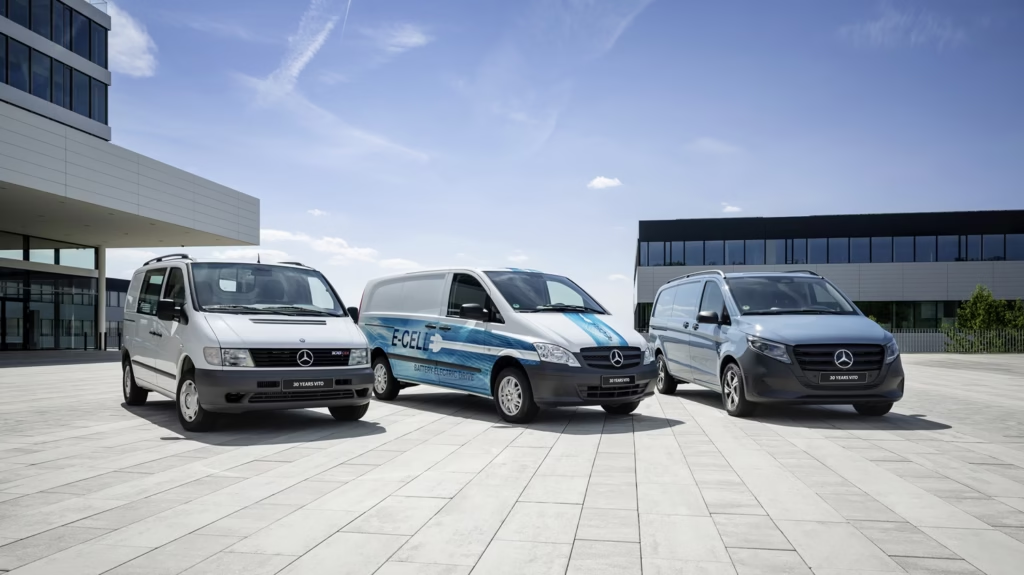
Mercedes-Benz Vito: A success story
Since its launch in 1995, Mercedes-Benz Vito has provided a solution tailored to the needs of traders and service providers. It is a versatile and reliable model in its segment.
Key Milestones
1995: The first generation with diesel and gasoline four-cylinder engines, mounted transversely
With the launch of the first-generation Vito in 1995, Mercedes-Benz introduced an entirely new van in the 2.6–2.8-ton class. The front-wheel-drive vehicle combined attractive design with compact dimensions and, with a payload of one ton, was also suitable for transporting heavy goods.
The loading space of 3.6 m² offered a loading volume of almost 5 m³, allowing the easy transport of bulky objects. Thanks to its small size and a height of 1.89 meters, Vito was also ideal for multi-level car parks or city garages.
The first generation also featured multiple safety equipment items as standard, impressive for that time. These included a driver airbag, independent wheel suspension, disc brakes on all wheels, ABS with automatic braking differential, and power steering.
The diesel and gasoline four-cylinder engines, mounted transversely, stood out for their low fuel consumption while offering attractive performance. Users appreciated the efficiency and flexibility of the Vito model, which earned it the title “Van of the Year” in 1996. In 1999, the model received a facelift, new paint shades, and equipment upgrades. By 2003, Mercedes-Benz had sold approximately 473,000 vehicles (of the first generation).
2003: The second generation, with more comfort and greater diversity
For the second generation, the entire vehicle was redesigned. All versions switched from front-wheel drive to rear-wheel drive, which improved driving dynamics and load capacity. With a payload of up to 1,295 kg, Vito became a true benchmark in the segment. An all-wheel-drive version, the first in its segment, further increased its versatility.
The available engines were more powerful, ranging from efficient four-cylinder units to high-performance V6 engines. With three body lengths, two roof heights, five engine options, and numerous optional features, the second generation paved the way for today’s diverse range.
In 2005, the European jury once again named the Mercedes-Benz Vito “Van of the Year”. By 2014, the second generation surpassed its predecessor’s remarkable success, with nearly 750,000 units sold worldwide.
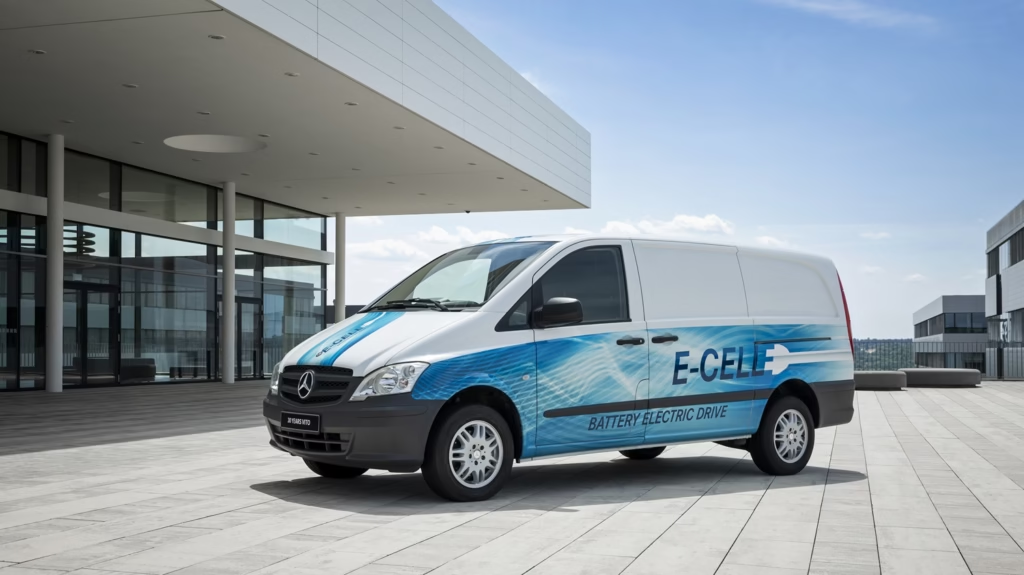
Additionally, the second generation marked an important milestone in the electrification process: with the launch of the Vito E-CELL in 2010, Mercedes-Benz began small-series production of an electric van equipped with a 70 kW (95 hp) motor. It offered a range of approximately 130 km and was successful in areas such as courier services (express deliveries and parcel distribution).
2014: The third generation brings a new design and more space
In 2014, the third generation of the Vito model premiered worldwide. More versatile and economical, with improved safety features, this new generation was launched with a fresh design and three drive variants. Customers could choose between front-wheel drive, rear-wheel drive, and all-wheel drive.
With an unchanged wheelbase, the Vito became up to 13 cm longer, with a maximum length of 5.37 meters, offering more space for cargo and passengers as well as an increased payload of 1,369 kg.
In 2018, the eVito was launched, the first mass-produced midsize electric van from Mercedes-Benz. The third generation also set new safety standards: the Vito van was the only vehicle in its class equipped as standard with airbags and seatbelt warnings for both driver and passenger. The Vito Tourer offered up to eight airbags for all passengers. Unique in its segment at the time, the Crosswind Assist was included as standard equipment.
The fully electric eVito has been on the market since 2018. Whether used for deliveries or commercial passenger transport, the eVito followed the E-CELL model, constantly introducing technological advances.
In 2020, a new update brought numerous improvements: the new four-cylinder OM 654 diesel engines offered increased power combined with reduced fuel consumption. In addition, the new generation was equipped with the 9G-TRONIC automatic transmission, an optional digital rear-view mirror, the automatic distance-maintenance assistant DISTRONIC, improved assistance systems, and new comfort features such as the AIRMATIC air suspension.
2024: The current model brings a new level of connectivity and comfort
The latest update came last year. The MBUX multimedia system introduced modern infotainment, improved connectivity, and new digital features to further enhance comfort. As a result, the Vito and eVito models are fully integrated into the brand’s digital ecosystem. Safety features were also improved and expanded, for example with the Active Brake Assist system, featuring cross-traffic detection and lane-keeping assistance.
The exterior was updated with Multibeam LED headlights, while the interior was enhanced with elements such as the new central console and the EASY-PACK electric tailgate. Standard equipment was significantly improved, and the range of versions was better tailored to customer preferences. For the first time, engine options were extended to include a petrol engine with mild hybrid technology.
The current eVito wins customers over with zero CO₂ emissions driving technology, full connectivity, and a range of up to 480 km (WLTP), making it highly suitable for daily tasks.
Vito: Manufactured in Vitoria for 30 years
The Vito model has been produced, from the very beginning, at the historic plant in the capital of the Basque Country, Vitoria-Gasteiz, from which it also takes its name. Being the second-largest production capacity for Mercedes-Benz commercial vehicles, it is one of the most important Mercedes-Benz Vans factories worldwide. In addition to Vito and eVito, the plant also produces the V-Class and EQV models.
For over 70 years, the Vitoria plant has been synonymous with craftsmanship, modern production technologies, and strong regional ties. Covering a total area of 696,000 m², the production buildings currently occupy 373,000 m². The number of employees is 4,800.
In March 2024, the foundation stone was laid for the expansion of the plant: starting in 2026, vehicles based on the fully electric VAN Electric Architecture (VAN.EA) platform will be produced here. Continuous investments in infrastructure, digitalization, and training transform this plant into a future-proof pillar of the global Mercedes-Benz Vans production network.


