


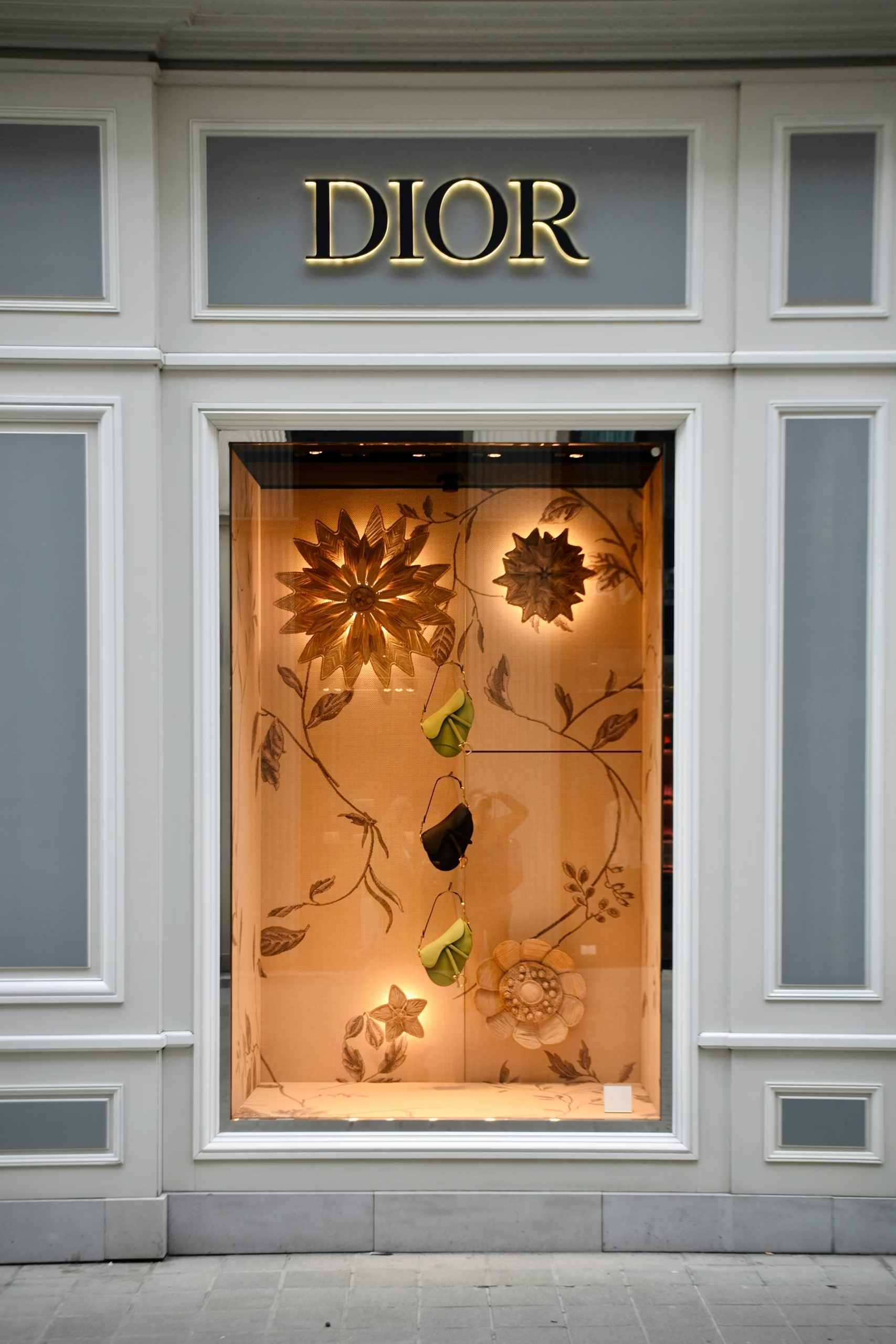
On a Roman evening steeped in cinematic romance, Maria Grazia Chiuri unveiled her final collection for Dior in the storied gardens of Villa Albani Torlonia. ‘Les Fantômes du Cinéma’ isn’t just a Cruise collection—it’s a farewell letter stitched in symbolic embroidery, spectral lace, and silhouettes that feel pulled from a dream sequence. Rome doesn’t just serve as a backdrop here—it’s the soul of a vision that closes a powerful era in feminine fashion.
The Last Curtain Call
The garden of Villa Albani Torlonia shimmered under a Roman dusk on May 27, 2025—light falling in cinematic slants across marble busts and stone fountains, casting silhouettes that looked less like models and more like phantoms passing through a dream. It was here, in a setting soaked with Enlightenment art and storied aristocracy, that Maria Grazia Chiuri staged her final bow for Dior.
“Les Fantômes du Cinéma”, the name of this Cruise 2026 collection, translates to The Ghosts of Cinema. But what Chiuri conjured in Rome was more than a retrospective or a farewell. It was a séance. A calling forth of muses, myths, memories, and one last magnificent expression of a nine-year creative reign that redefined what it means to dress and address women.
Les Fantômes du Cinéma — Ghosts Wearing Couture
Chiuri has always worked like a director, orchestrating fashion as mise-en-scène, each collection a new act in an ongoing film of feminist poetics. But this season, her reference point was more literal—and more personal.
Les Fantômes du Cinéma unfolds in a dreamlike temporal space, echoing the bella confusione—or “beautiful confusion”—that screenwriter Ennio Flaiano once proposed as the title for Federico Fellini’s 8½. Like Fellini’s semi-autobiographical film, this collection blurs memory and imagination, narrative and costume. It is both memoir and masquerade, a tribute to Rome’s role in shaping Chiuri’s creative DNA and a final cinematic flourish before the credits roll.
The Spirit of Mimì — The Eternal Muse
At the heart of this collection stands an unexpected muse: Mimì Pecci Blunt, an early 20th-century cultural dynamo who split her time between Rome, Paris, and New York. A patron of surrealist art and the hostess of mythic costume balls, Mimì was a woman who knew how to turn life into performance.
For Chiuri, discovering Mimì’s world was a revelation—a portal into another kind of femininity: masked, theatrical, free. The idea of a Bal de l’Imagination, one of Mimì’s famed soirées, provided the visual spine of the show. Chiuri, ever the feminist dramatist, used this premise to explore disguise not as deception, but as emancipation.
To dress up, in this collection, is to transcend.
Stitching the Séance — Key Looks and Metaphors
Fashion, for Chiuri, has always been semiotic. Here, garments become ghosts in their own right—fragments of historical memory recomposed through contemporary syntax.
Military Romanticism
Men’s tailoring is softened, subverted. Tailcoats with long, sweeping skirts suggest a kind of romantic resistance. Military jackets—black-edged, buttoned with quiet authority—recall not war but revolution.
Lace and Bas-Reliefs
Chiuri juxtaposes whisper-thin lace with embroidery that mimics the texture of sculpted stone.
The effect is tactile contradiction: fragile but enduring, like a fresco still clinging to a Roman ruin.
Disruption of Color
While white is the show’s grounding palette—pure, spectral, expansive—it is interrupted. Red and black velvet mini dresses blaze like flickers of memory, direct homages to the Fontana sisters, who once dressed Anita Ekberg in La Dolce Vita. A golden velvet gown—liquid and regal—glows with finality.
Fragmented Narratives
Each look feels like a still from an unreleased Fellini film: symbolic, self-contained, suggestive.
This is fashion as cinema verité—beautiful, incoherent, and utterly alive.
Farandole Fantasia — The Ensemble Cast
Models floated through the garden like a farandole—a winding chain dance, both ancient and avant-garde. Each was costumed as a different figment of the imagination: priestess, poet, phantom, soldier.
Together they performed not a runway show, but a rite. Chiuri’s choreography evoked something older than couture and more sacred than spectacle. If this were a finale, it refused to end cleanly, just as memory refuses to be neatly folded.
The White Thread — A New Mythology for Rome
Chiuri’s Rome is not the postcard version. It is not marble ruins or tourist myths, but rather a living, breathing woman—the eternal feminine. Her Rome is seen through the lens of artists, rebels, dreamers, salons, and sacred secrets.
She doesn’t just dress women; she reclaims archetypes.
Virgin. Muse. Warrior. Ghost.
In this show, the color white—rendered in everything from linen to lace, silk to wool—became not blankness, but a palimpsest. A canvas for new myths. A light for women navigating between past and present.
The Farewell Letter — From Maria, With Gratitude
And then, there it was. A farewell not in words spoken on stage, but in a post—poised, thoughtful—shared via Dior’s Instagram:
“After nine years, I am leaving Dior, delighted to have been given this extraordinary opportunity. I would like to thank Monsieur Arnault for placing his trust in me and Delphine for her support. I am particularly grateful for the work accomplished by my teams and the ateliers. Their talent and expertise allowed me to realize my vision of committed women’s fashion, in close dialogue with several generations of female artists. Together, we have written a remarkable and impactful chapter of which I am immensely proud.”
It was everything Maria had always been: composed, collaborative, and deeply committed to collective creativity.
A Legacy of Questions, Not Answers
Maria Grazia Chiuri doesn’t leave Dior with exclamation points or grand finales. She leaves with ellipses. With open questions. With silhouettes that ask “what if?” and fabrics that whisper “remember me.”
She departs not as a ghost but as a guide, having taught Dior—and fashion at large—how to honor women not just as bodies to dress but as voices to amplify, stories to tell.
In the garden of Villa Albani Torlonia, where the past dances with the possible, her last collection lingered like a sigh, like the last line of a great poem.
A beautiful confusion.
A Roman dream.
A legacy sewn into light.


